Serial Killer Exhibit Berlin

Official Text: 

»Manson, Bundy, Dahmer and more are waiting for you! Debunk the mysteries behind the most twisted minds of the century with an exploration of serial killers’ lives from a scientific, historical and educational perspective. See the never-before-displayed collection of hundreds of original artifacts, including documents and drawings of the most famous killers made by themselves. 

Step inside detailed recreations of the most famous crime scenes, and learn all about the FBI methodology to identify and analyze psychological profiles of these individuals.

Date: From September 6, 2025

Opening hours: Closed on Monday and Tuesday

From Wednesday to Friday, open from 10 AM to 6:30 PM, last entry at 5 PM.

On Saturday and Sunday, open from 10 AM to 7:30 PM, last entry at 6 PM.

Duration: 90 minutes

Location: Neukölln Speicher, Ziegrastraße 1, 12057 Berlin, Germany

Age requirement: Recommended 14+. Children under 14 are admitted only when accompanied by an adult. Please consider content suitability for a younger audience.«

Mark's foreword in the exhibition catalog

Vorwort von Mark

Serienmörderinnen und Serienmörder haben das „gute Gefühl“ für ihre Umgebung verloren. Sie sind einsam, jedoch nie verrückt. Sie können klar und ehrlich sein in dem, was sie zu wollen glauben – zu sich und zu anderen. Doch sich unsozial ausprägende Persönlichkeitsstörungen plus Geradlinigkeit: Das ist eine fiese Mischung. Im besseren Fall bewähren sich derart veränderte Menschen gut in Berufen, in denen sie eine Krise nach der anderen verwalten müssen. Im schlechteren Fall, töten oder verzehren (oder alles nacheinander) sie reihenweise Menschen.

Die Opfer von Serienmörderinnen und Serienmördern haben oft wenig bis nichts getan. Es sind Sex-Arbeiterinnen und Sex-Arbeiter, Hausangestellte, Kinder, Arme, Verführte oder Gutgläubige. Wenn wir Serienmorden vorbeugen wollen, müssen wir daher Täterinnen und Täter verstehen. Denn Menschen ohne Argwohn und Schutz, also die liebsten Mordopfer der Serientäterinnen und Serientäter, wird es immer geben. Diese Seite der Geschichte ließe sich nur in einer heilen Welt ändern. In der Kriminalistik leben wir aber nicht im Glitzermärchen.

Auch Polizistinnen und Polizisten sowie andere Beteiligte erwischt es regelmäßig, wenngleich nicht als Getötete. Der Staatsanwalt meines Klienten Luis Alfredo Garavito (+ 2023), der über dreihundert Kinder vergewaltigte und zu Tode folterte, war bei meinem letzten Besuch so durcheinander, dass sich jedes weitere Gespräch mit ihm aus Rücksicht auf seine Nerven erübrigte. Der letzte Hoffnungsschimmer des kolumbianischen Rechtskundlers war, dass Gott ihm den fürchterlichen Garavito-Fall zugeteilt habe. Ich weiß bis heute nicht, warum das für ihn tröstlich sein konnte. Zumal es doppelschneidig ist: Denn „sein“ Serientäter Garavito war überzeugt, dass Gott mit ihm, dem Täter, am Ende aller Zeiten gemeinsam durch das Jenseits schreiten würde. Woher ich das weiß? Er hat es mir in eine Bibel mit Goldschnitt geschrieben, nachdem er im Gefängnis als Christ getauft worden war. Der einzige, der einigermaßen seelisch heil aus dem Fall herauskam, war Garavitos evangeliker Priester. Der hatte einig Jahre lang wegen Kokainschmuggels hinter Gittern gesessen und erst in seiner Heimat und dann im Gefängnis in den Vereinigten Staaten gelernt, dass das Gute und Schöne nicht vorwiegend hier auf der Erde zu finden ist.

Die an Garavitos Fall beteiligten Polizisten hatten den Müttern der verschwundenen Kinder zunächst nichts geglaubt. Vor allem nicht, dass die Kinder am hellichten Tag entführt worden sein könnten. Das haben sie später bitter bereut und nie mehr vergessen. Bis an ihr Dienstende versuchten sie, den Eltern Unterstützung zukommen zu lassen. Doch es war vergebens. Wer soll einer Mutter ein Kind ersetzen oder den verlorenen Glauben an die Gerechtigkeit?

Manche der Polizisten vor Ort fragten mich, ob die ländliche Musik in Garavitos Heimat ihn zum Serientäter gemacht haben könnte. Das zeigt: Der weg von solchem Aberglauben bis zur wirksamen Für- und Vorsorge ist in einem armen, von Gewalt geprägtem Land allzu lang. Und es stellt eine Gemeinsamkeit zur längst widerlegten Aussage dar, dass Computerspiele, Kinofilme, Comics oder ähnliches Gewalt auslösen würden. Doch so einfach ist es nicht: Alle Medien können Gutes ebenso fördern wie Schlechtes. Darüber entscheiden nicht zuletzt die Umwelt und die Persönlichkeit der Betrachterinnen und Betrachter.

Zu derartigen Missverständnissen kommt es im für viele Menschen spannenden, aber nicht in der Tiefe ergründeten Feld des Serienmordes öfter.

So etwa bei Jeff Dahmer (+1994): Neuerdings durch Netflix, ein superbes Comic seines Schulkameraden, wieder veröffentlichte Gespräche mit dem Täter sowie ein älteres Buch seines Vaters – all diese Veröffentlichungen erzählen auf unterschiedliche Weise vom Leben und den Taten eines der bekanntesten Serienmörder. Ein Monster, eine Bestie, ein Psycho – keine Frage. Und doch, wenn ich die Aufzeichnungen der Gespräche mit ihm sehe, sitzt da vor allem ein grundehrlicher, ruhiger Mensch, der allerdings nicht den Hauch einer Ahnung hat, wie tragfähige und gesunde Beziehungen aussehen könnten. Jedenfalls gelingen sie nicht durch das Einspritzen von Drogen in den Schädel und dem Lauschen am Herzen des „Partners“.

Das hat sogar Dahmer selbst eingesehen. Eigentlich hat er sogar alles eingesehen. Doch bis heute gibt es keine sichere Therapie für seine Persönlichkeitsstörungen. Nichts hält die Täterinnen und Täter auf, obwohl sie Einsicht zeigen. So kommt es, dass es immer neue Serienmörder gibt, selbst dann, als niemand mehr glaubte, dass dies dank Kriminaltechnik und Massendaten noch möglich sei. Das unerwartetste Beispiel dafür ist Samuel Little (+ 202). Es war nicht einmal bekannt, dass eine lange und unerkannte Serie von Morden vorlag (ja, vorwiegend an Sex-Arbeiterinnen und ja, mehrfach dachte man, sie seien an Drogen oder durch Unfälle gestorben).

Auch bei deutschen Tätern gibt es schon lange viel zu entdecken, weil viel aufgeschrieben wurde. Märchenhaftes überschattet nicht selten einen nur noch glimmenden Kern. Wussten Sie beispielsweise, dass die Ehefrau des Frauenmörders Peter Kürten (+ 1931) einigen der weiblichen Opfern ins Gesicht sagte, sie sollen sich von ihrem Mann fernhalten, weil er wirklich sehr gefährlich sei? Dass der einst gefürchtete Serienmörder Bruno Lütge (+ 1944) die dreiundfünfzig Morde „im ganzen Reichsgebiet“ gar nicht durchgeführt haben kann? Und dass die Nazis, um zu verhindern, dass der Unsinn um die von Lütge nachgeplappert gestandenen Morde aufflog, erst gar keine Gerichtsverhandlung anberaumten? Er starb übrigens unter ebenso ungeklärten Umständen wie der Kannibale Karl Denke (+ 1924, 31 Morde), der sich angeblich in seiner Zelle an einem großen Taschentuch erhängt haben soll.

Wie sehr die Täter mehr als alles andere beziehungsgestört sind, zeigt sich am deutschen Jungenmörder Jürgen Bartsch (+ 1976). Er hatte Kerzen nicht etwa stets im Gepäck, um seine Opfer zu foltern – das wäre angesichts einer Abbildung gesetzlich erlaubter Kerzen-Folter im Strafgesetzbuch von Maria Theresia zumindest denkbar gewesen: „Mit einem Kerzenbündel unter den Achseln brennen.“ Nein, Bartsch wollte seinen Opfern ein Lichtlein in der Dunkelheit gegen ihre kindliche, allerdings keineswegs kindische, Todesangst geben: Er lagerte sie tags in einem Stollen, um die Kinder nachts dann zu Tode zu foltern. Außerdem, so seine Aussage, verbreiten Kerzen doch eine angenehme Stimmung, so wie sie Erwachsene im flackernden Licht erleben, wenn sie sich – laut Bartsch – „ganz doll lieb haben“.

Bartsch wand sich darum, zuzugeben, die Opfer zu geküsst zu haben oder gar nekrophil zu sein. Doch wie auch bei Jeffrey Dahmer platzte die Bindungsstörung in der Befragung ungewollt aus ihm heraus: Er hatte sich sehr wohl an den Leichen der von ihm zu Tode gefolterten Kinder zu schaffen gemacht, aber nur, weil diese Art der schlimmst möglichen Bindung für ihn so unendlich angenehm war.

Er wollte den für ihn schönen, befreienden und beruhigenden Moment genießen. Das wusste er und das sagte er selbst. Doch niemand glaubte ihm. Hätten die Menschen damals das Fürchterliche für wahr gehalten, hätten viele Tagen anderer Menschen, die ebenso bindungsgestört waren und sind, verhindert werden können.

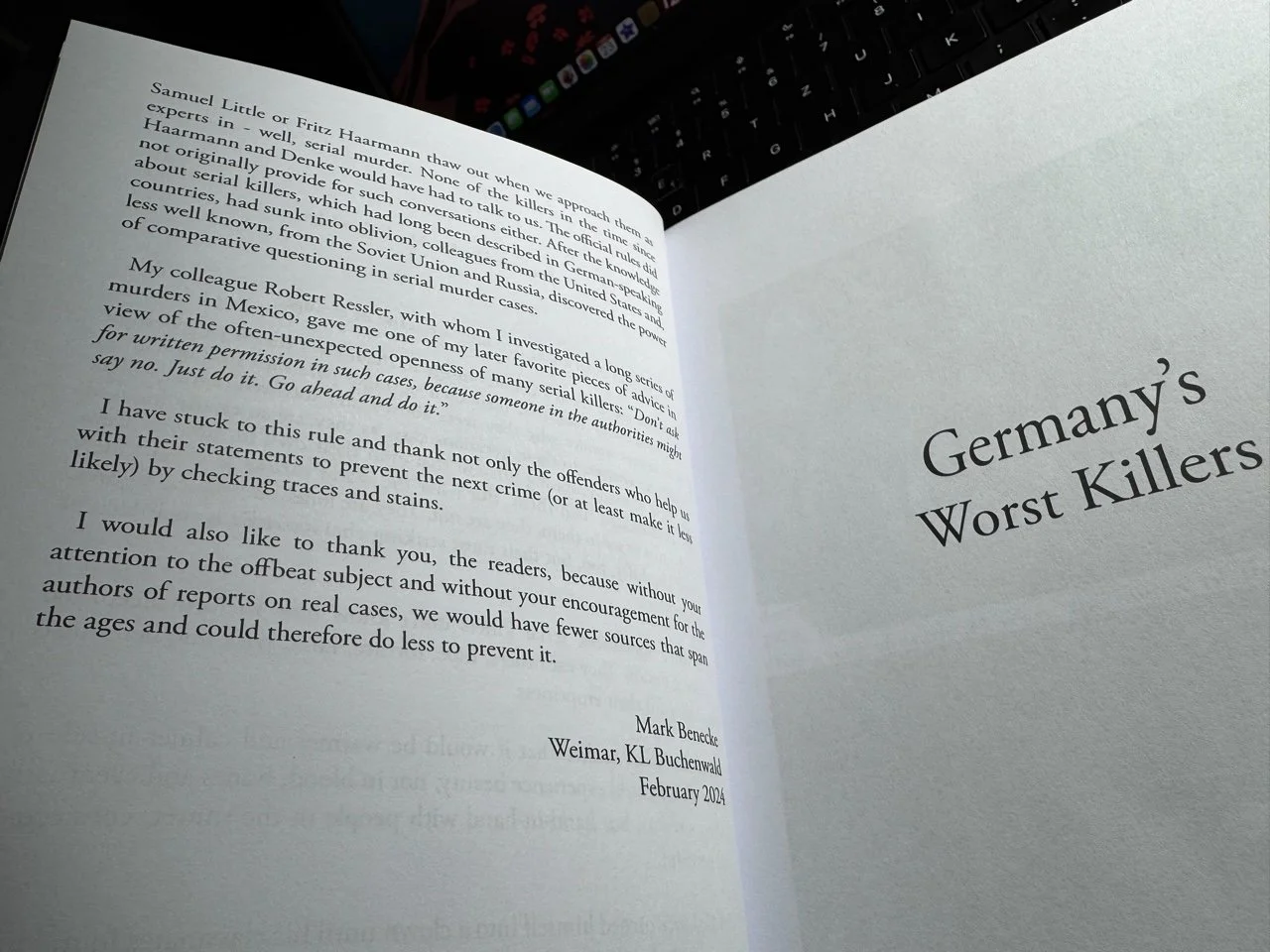
Preface: Germany's Worst Serial Killers

In: Jean Rises: Germany's Worst Serial Killers. Serial Pleasures Publishing, 2024

Foreword by Dr. Mark Benecke

Some find serial killers dazzling, attractive or strange.

Others need a counter-image to themselves that is so gruesome and undeniably bad, that their own outrages pale into insignificance.

Still others wonder why they were abused and tortured. Serial killers make the answers to these questions easy, as they are so clearly on their human-despising mission that even their own tormentors seem less complicated.

But what the world throws at serial killers and wants to see in them, they are not. They are lonely, deeply sad figures. And pushed. Shifty, too, but their most striking characteristic is their lack of commitment.

In their loneliness, serial killers don't know how to form deep and trusting bonds. They eat others, rape, torture, hunt, trick and lie. This is how they fill their emptiness.

But they don't realize that it would be warmer and calmer inside of them if they could experience beauty not in blood, bones and eventually fading screams, but hand in hand with people in the sunset, connected and peaceful.

Jeff Dahmer turned himself into a clown until his classmates found him too creepy. Peter Kürten hoped to hear his own blood rushing when he was beheaded, and my client Garavito sincerely believed that God and he could colonize a loving and understanding realm together.

For whatever reason you picked up this book: It is one of the most impressive experiences in criminalistics when and that we see that perpetrators like Samuel Little or Fritz Haarmann thaw out when we approach them as experts in - well, serial murder.

None of the killers in the time since Haarmann and Denke would have had to talk to us. The official rules did not originally provide for such conversations either. After the knowledge about serial killers, which had long been described in German-speaking countries, had sunk into oblivion, colleagues from the United States and, less well known, from the Soviet Union and Russia, discovered the power of comparative questioning in serial murder cases.

My colleague Robert Ressler, with whom I investigated a long series of murders in Mexico, gave me one of my later favorite pieces of advise in view of the often unexpected openness of many serial killers: "Don't ask for written permission in in such cases, because someone in the authorities might say no. Just do it. Go ahead and do it."

I have stuck to this rule and thank not only the offenders who help us with their statements to prevent the next crime (or at least make it less likely) by checking traces and stains.

I would also like to thank you, the readers, because without your attention to the offbeat subject and without your encouragement for the authors of reports on real cases, we would have fewer sources that span the ages and could therefore do less to prevent it.

Mark Benecke
Weimar, KL Buchenwald
Februar 2024

Book Review: 'Who They Were' by Bob Shaler (NYC OCME / WTC DNA) 🌇

This is very valuable book because it tells the inside view straight from the point of laboratory organization and management as well as techniques used after 9/11 in Manhattan. It will disappoint readers who want to know about life stories of single victims of the WTC attack; that is not the topic of the book.

Bob Shaler was very much driven to identify the victims as far as possible in-house and to coordinate as much as possible himself. The Office of Chief Medical Examiner was (and is) under direct command of the Mayor's Office, so it was bound to City of New York and during the WTC times many other policies. (Often, Institutes for Legal aka Forensic Medicine belong to universities, are academic institutions and are therefore run a bit differently.) Our* lab was massively expanding under Bob Shaler, at the end of the 1990s, we were around 50 scientists there. When 9/11 happened, the number of scientists had doubled. Sexual crime had become a focus of attention under then mayor Rudy Giuliani, so many "sexual assault kits" came in, containing underwear, swabs, hair and more, mostly taken from the victims. Shootings and knife wounds were less common compared what some people think because guns and knifes were already strictly banned at that point in the city. (For example, I was scolded twice by Bob Shaler for having a small swiss army knife in my pocket and had to remove it.)

In the middle of this lab expansion, the sexual crime stains pouring in and the urge to speed up case turnover time in the lab, as well as the police bringing in lots and lots of material which they thought might be useful for stain analysis — anything containing a stain which was a lot in blood stain cases, e.g., phone books, sneakers etc. —, the first World Trade Center Tower fell. 

The head of OCME, forensic pathologist Charles Hirsch as well as colleague Ristenbatt from the DNA department immediatly went downtown (which is not too far from the office) and got cought in the fall of the second tower: No more connection to them. This is one of the moments in the book where Shaler mentions that everyone was shocked but does not mention that both survived (until much later in the book). 

Shaler also mentions that he became "less happy" as a person over the course of the events, and that much later, bone fragments were found that came from the persons in the airplanes that crashed into the towers. I mention this as a warning that even though everyone was deeply affected by the events, the book is not emotional. If you wish to read an emotional account, this is not your book.

Instead, Shaler gives a very precise timeline of which laboratories he asked for help and who in the laboratory became responsible for which part of the DNA work. He mentions all the names of persons involved, and it sounds a bit like a historical writing to me — so that the facts will not disappear in time and space.

The determination he put into the WTC work is most obvious to me when the number of identifications went down and — in my opinion — very minor misidentifications took place. Shaler then set up a grid and tried the impossible: To match the three-dimensional structure including every single person who had still been in the building to the comparably two-dimensional, collapsed rubble into which the mostly very small body parts were mixed after the towers fell. I would have thought such calculations to be unfeasible — but he did it. I find the results amazing; they are in the book.

If you come from the field of forensic biology, you will not mind the numerous abbreviations that Shaler uses and that are common use in our field like SNP, STR, KADAP, OCME, DM, MDKAP, WTC CODIS, MFISys. All is explained, of course, but for a reader from a different field, you may wish to consult the glossray and the index at the end of the book. What I find very cool is the 'Cast of Characters', also at the end of the book. It is a honorable move to include many of the scientists and organizational staff that took part in the identification process.

After reading Bob's book, I understand the many decisions that had to be made in-house concerning the involvement of others. One of the software programmers for example, a mathematician, was quite a character and Shaler had to decide which parts of the statistical work (to connect stain to stain to anything the relatives of missing persons delivered, e.g. toothbrushes) to give him. 

Same for Craig Venter, then an absolutlely famous person for decoding the human genome after speeding the 'race for the human genome' to the max. He offered Shaler close to unlimited help which sounded possible and nice on the one hand. On the other hand, Venters experience was not forensics, and his company later decided (Shaler ponders) that unpaid or hardly paid work for a good cause might damage their revenue. 

Also, I now realize how difficult it is to communicate all to everone who needs information in a mass disaster situation (and probably also during day-to-day work in a large lab). 

Some stories are not told, of course, and since there may be a reason for this, I will leave it like that. 

Shaler's book is unusual since it is a popular science book that avoids tearful comments wherever possible and focuses on procedures, processes, genetic fingerprinting, agencies and persons involved. There are brief exceptions, though, mostly relating to the contact with the victim's families. The relatives had high hopes to science and identification even though they were often facing total destruction or decomposition of the body parts: "Their grief was exhausting, and while I tried to remain detached and not watch, it was impossible." 

What Shaler does not write is that the whole area around the office was literally plastered with self-made posters of missing persons, and that many people where standing in front of the Bellevue hospital entrance next to the OCME — quietly, looking for a glimpse of information, not walking away.  

More than once, Shaler mentions that probably god pushed him into the direction of his — this — job. For Bob, it was the most important task of his life. He also mentions that for younger scientists in the lab, it might be difficult to work on the most important case of their lives at the beginning of their careers because afterwards, work might be less intense. From my experience, this matters not because at the end of the day, a case is a case, and all cases should be treated equally. Probably his statements are proof to the shell shock that WTC caused to so many (including me). 

After the World Trade Center DNA investigation was closed, Bob Shaler resigned at the OCME. He then set up a forensic program at Penn State University. In 2010, he retired from forensic work.   

* I worked in the forensic biology (i.e., DNA) department of the NCY OCME  from 1997 to 1999. Bob Shaler was my direct boss; Mecki Prinz from the OCME DNA lab was my first forensic boss in Germany. Briefly after the WTC fell, I went to Manhattan, talked to my colleagues and wrote a popular science article about their DNA efforts → https://home.benecke.com/publications/nicht-sachen-sondern-menschen


The Batman, Riddler, Catwoman & Pinguin

September 2022


Der Herr der Maden

max | 1998


Das sind nicht Sachen, sondern Menschen

WTC


Der Zuckerfass-Mord

New York | 2018


Arbeitsplatz New York

Galerie


Mit Maden dem Täter auf der Spur

Das Goldene Blatt | 1999


Gutachten: Überführen Maden

1998

Noble Blood Vampire Chronicles

Hardcover, 184 glossy pages, 16 vampire models + 10 victims, Book size: 24 x 36 cm,
ISBN: 978-3-00-043480-8, € 54,00 (D)

English version

Preface by Mark Benecke

Magic is something not to be dealt with lightly, and vampyrism even more so. Worst of all, both matters can hardly be poured into photos.

There is one being, however, who does have the inner glitter, strength and insight to understand fairies, wood elves, vampires and vampyres in a way that allows her to take meaningful photos of them. This being is, of course, Viona Ielegems.

For years, her photgraphs and projects brought joy into the brighter shades of forests, transformed a simple lawn in the city of Leipzig into one of the most peaceful and beautiful events of the already peaceful and beautiful annual gothic meeting and did a fairy calendar that, when I put it on stage at a gothic festival, was the number one must-have item there. In her new book, Viona delves even deeper.

When I saw her for the first time several years ago, I knew that she came from (or decided to live) in a very different world compared to the ugly and meaningless surroundigs that many worn-down regions in central europe force us to stay in. She loves cupcakes, for example, but not in the tattoo-and-rockabilly fashion that is just a transient trend but in a sweet, personal and fairytale way. She loves Victorian costumes but not in the Eyes Wide Shut sense but in a deeply romantic manner. She owned a pair of blue peafowls as if that was something normal, and now she lives in a castle. Whew!

This castle, a former hunting space, is so beautiful I won’t even start to describe it. We just had a real life vampyre meeting there, and everybody was sure they had found the one place where full acceptance for all creatures of the night -- with a positive light glowing inside of them I mean --, as well as all children of goddess Diana found their home and -- like i said -- peace and quiet.

Here, in Castle Heinrichshorst, in the middle of the German total nowhere, she chose the finest possible selection of models (some of them vampires, few of them vampyres, some of them just radiantly beautiful in the gloomy yet glowing spirit of phantastic fashion) to shoot a book that is certainly not from this world. Then again, how could it -- it was Viona who did it.

Please enjoy not only the brilliant pictures, the very cool, lovely and well chosen models as well as the atmosphere and deep vibe of the castle that is very much part of the photographs. Please also enjoy the fine, elegant, fashionable and sophisticated photographer who makes magic a fine thing to exist, and who certainly knows where vampires linger, lure and lark.

Come in, and come out, wherever you are. IF YOU WISH:

Mark Benecke

Forensic Biologist

President, Transylvanian Society of Dracula etc. etc. ;)


Deutsche Version

Vorwort von Mark Benecke

Die drei häufigsten Fragen an mich sind, ob mein Job nicht ekelig ist, wie man bei uns ein Praktikum machen kann und ob es Vampire wirklich gibt.

Natürlich gibt es sie. Sie laufen als Nervensägen durch die Gegend und stehlen uns Zeit und Energie. Sie lieben stärker, als das gottgefällig ist und bringen damit den ganzen Laden durcheinander. Sie fürchten das Helle, weil sie im Dunklen erst Schutz finden und darum später vor allem im Schatten klar sehen. Das ist oft genug auch eine Stärke.

Bis heute gibt es zudem eher tragikkomischen Fehldeutungen, wenn beispielsweise verfaulte Leichen ausgegraben werden, denen flüssiges Blut aus dem Mund läuft. Müsste es nicht eigentlich stocken? Und warum sind die Fingernägel so lang, die Augen so hell und klar? Dass da zwar alles stimmt, die meisten Menschen aber die Zersetzungsformen von Leichen nicht kennen und eh nur solche ausgraben, die vorher schon als Hexer, Vampire oder Nachzehrer galten, fällt unter den Tisch des gruseligen Glaubens.

Ich selbst mag eher Real Lifer, mit denen ich übrigens auch schon Gast auf Schloss Heinrichshorst war. Unter dem Fittich der dort beheimateten Göttin der Jagd haben wir friedliche, magische und erquickliche Tage und Nächte gelebt. Das einzige auffällige war, dass die Anwesenden, die sich selbst als Vampyre bezeichnen, einen tiefen Sinn für samtweiche Sonderlichkeit und einen erlesenen Kleidungsgeschmack hatten. I like!

Weil Viona wünscht, hier nicht über den schwarzen Klee gelobt zu werden, will ich zum vorliegenden Buch nur sagen, dass außer ihr niemand -- absolut niemand -- eine derart ausgesuchte Auswahl von Vampiren, Vampyren und Romantigoths vereinen und in blutrote Szene setzen konnte. Dafür hat sie den Preis der finsteren Lüste, fantastischen Fabeln und blutig-stylishen Hoffnungen verdient. Da es den Preis nicht gibt, bitte ich, die Künstlerin auf jede sonst mögliche Art zu ehren. Das einzige, was ich nicht ganz verstehe, ist die Tatsache, dass Victoria Frances und Father Sebastiaan im Buch vorkommen. Das klappte wohl nur, weil heutige Kameras meist keine Spiegel haben.

Wenn wir in hundertfünfzig Jahren auf die moderne, bis dahin historische, Vampirkultur zurückblicken, werden wir die fotografischen Gemälde aus diesem Buch verwenden. Das ist eine sehr beruhigende Aussicht.

Berlin, August 2013

Mark Benecke

Transylvanian Society of Dracula


Nosferatu in Berlin

Live cinema screening


Blutige Vampir-Tränen

Radio-Interview


Creeper versus Dracula

Splendid Films