
Forensic medical officer is a heavy and unattractive work for most people. It happens all the time that you have to face the incomplete and smelly corpses. Out of our imagination, Mark Benecke is a unique figure in this field, and by achieving a great idea in his work, Dr. Mark becomes a world-renowned forensic entomologist. Mark Benecke was born in 1970, in Bavaria, Germany. After receiving a Dr. rer. medic. at Cologne University in 1997, he worked in the Chief Medical Examiner's Office in Manhattan, New York from 1997–1999. As of 2008, he works internationally on forensic cases as a freelance expert witness. He also teaches at various police academies and acts as a visiting professor to universities in Germany, England,Vietnam, Colombia, and the Philippines.
Read MoreBeliefs and Behaviours in Education and Culture
To determine psychological, biographical and life style parameters in a large, active, real-life vampyre subculture, we used an internet- based questionnaire with special features, including strict inclusion criteria, missing outgroup and proof of existence of all participants.
Read MoreThe Restless Dead: Vampires and Decomposition
Cemetary historian David Pescod-Taylor and forensic biologist Mark Benecke think there's a simple explanation for why people believed in the living dead. Their theory involves decaying corpses and unfortunates suffering from misunderstood diseases...
Read More2014 08 International Congress of Dipterology
n July 2012, over several days and nights, our team examined 622 mummies in the basement of the Capuchin monestary in Palermo, with corpses dating back mostly between the 17th to 20th century. The mummies passed through different, mixed stages of decay, even though their decompositional end state is mummification.
Read MoreZum Liebespfeil der Schnirkelschnecken (Helicidae): Funktion und experimentelle Strukturaufklärung
Der Liebespfeil von Schnirkelschnecken ist auch Nichtmalakologen oft bekannt. Dies ist umso verwunderlicher, da sowohl zoologische als auch populärwissenschaftliche Darstellungen - wenn überhaupt - meist nur in einem Nebensatz auf das Gebilde eingehen. Darüberhinaus gilt das "Liebesleben der Weinbergschnecke" im Volksmund als Sinnbild einer abstrusen und langweiligen wissenschaftlichen Thematik.
Read MoreInterview on Vampirism – My research project about Vampires
Interviewer: Alejandra Arredondo... I’ve come across the theory that many people believe that vampires do not exist and all the stories are just a myth. However, I believe otherwise. There has to be some reason that there are so many movies and television shows that broadcast vampires. This is why I came to you for guidance. I want to be able to fulfill my task in this research project vastly. The purpose of my project is to open the eyes to my fellow colleagues the truth behind vampirism, and the importance of it ... (Alejandra Arredondo)
Read MoreVom wunderlichen Treiben atlantischer Küstenschnecken
Nachts, wenn draußen die eisigen Novemberstürme toben, denkt Patrick O'Baldraithe zurück an seine Kindheitstage. An den grauen Felsen der irischen Westküste wohnte damals ein verschrobener Alter. Oft wanderte der Alte den steinigen Strand auf und ab und es schien, als wollte er sich dabei jedes Fleckchen Erde unter seinen Füßen einprägen. Manchmal sahen die Kinder, daß er einen kleinen Gegenstand so weit wie möglich in Richtung Meer warf. Der alte Kauz konnte dann viele Stunden auf einem der riesigen Gesteinsbrocken am Strand zubringen, ohne sich zu rühren. Wenn ihn nicht zuvor die steigende Flut von seinem harten Sitz vertrieb, starrte er solange auf die glitzernde Wasserfläche, bis die Sonne in den abendlichen Wolken versunken war. Niemand, so erzählen es die alten Fischer noch heute, hat je erfahren, worauf er dort wartete.
Read MoreNiedere Tiere in königlichem Gewand Musterbildung bei Schnecken Benecke CCI
Im pazifischen Makin Marakei soll es früher als Mutprobe gegolten haben, lebendige Conusschnecken zu erbeuten. Mehr als einmal hatten die Tiere einen ihrer bis zu fünfzig Giftzähne auf die tapferen Taucher abgeschossen und bei diesen zu Kopfschmerz, Atemlähmung oder sogar Herzversagen geführt.
Read More1998-12 AIR: Solution for the Chicken/Egg Problem by use of Toothpaste Arithmetic
Some science problems are eternal, and others nearly so. Pierre de Fermat's famous mathematical poser, for example, appeared in 1619, and lurked for 374 years before someone found a way to solve it. An even harder question has been wlth us practically forever:
"Which came first - the chicken or the egg?" Now, thanks to a simple discovery, I have cracked this heretofore maddening problem.
1998 Skeptical Inquirer: Spontaneous Human Combustion
Paranormal proponents and popular articles are quick to attribute certain dramatic fire-death characteristics to an unknown or bizarre power source, but in all such deaths documented in forensic literature, there has been no need to resort to bizarre interpretations to account for the observed facts.
Forensic scientists very rarely, if ever, mention the (alleged) phenomenon of spontaneous human combustion (SHC). After reading an article on the subject in BILD, Germany's most famous tabloid newspaper (circulation four million daily), I started to wonder about this.
Read More2011-07 AIR: Criminal Investigator on Lint
Lint balls from navels (navel fluff, belly button fluff) won an Ig Nobel Prize in 2002 for Karl Kruszelnicki. Dr. Kruszelnicki worked on observations reported in a survey of 4799 lint-collecting people, rather than on tons (I use that word here metaphorically) of individual balls from a single person.
I am a forensic investigator, with a new (to me, I mean) interest in lint. I mentioned this during a radio program. A few weeks later, a young couple (Elisabeth and Jan from Dresden) approached me after a public lecture and handed me a full collection of lint balls collected exclusively from their own navels. This allowed me to examine 167 lint balls from two persons instead of many different lint balls from a large number of people.
Read More2005-10 AIR:Exploading Toads
Earlier this year, news reports described a sudden plague of exploding toads in Hamburg, Germany. The reports carried conflicting descriptions and speculation from scientists, governmental officials, passersby, and other authorities -- some said these were spontaneous explosions, some attributed them to attacks by killer crows, some to bacterial or viral action.
Others advanced still more exotic theories. The public was left with a confused notion as to what exactly had happened, and how and why. To make sense of the reports, we assembled an international "dream team" -- three extraordinarily curious, determined scientists, each of whom has a deep background in one or more elements of the apparent story. Their assignment: to try to discover the truth about the exploding toads of Hamburg.
Read More2005-09-25 Mark Benecke: Nematoden und Hieroglyphen
Source: Annals of Improbable Research 1(2): 17-18, click for the article
Nematoden und Hieroglyphen

Mikroskopisch kleine Fadenwürmer kommunizieren mit Menschen, indem sie sich zu Hieroglyphen zusammenlagern. Beweise dafür liefere ich im Buch Der Einfluß von Erdnußbutter auf die Erdrotation (Birkhäuser, Basel, Herausgeber: Marc Abrahams (Cambridge, USA), 1999, ISBN 3-7643-5941-2), das auch noch eine Reihe weiterer knorker Wissenschaftshumorabhandlungen beinhaltet, etwa:
Mikroskopie mittels eines gewöhnlichen Fotokopierapparates
Der Surferin-Pilz und die internetfähige Barbie
Aerodynamik von Kartoffelchips (mit echten Versuchen im Windkanal)
Ein Mann, eine Frau, eine Hefe
Elektroschockbehandlung bei Klapperschlangenbiß (Arzt und Patient haben einen Medizin-IgNobelpreis erhalten)
Das Micky-Maus-Gen - und so weiter und so fort...
Das dufte Buch oben ist zwar leider ausverkauft, allerdings gibts zum Glück und stark erweitert die folgenden Titel:
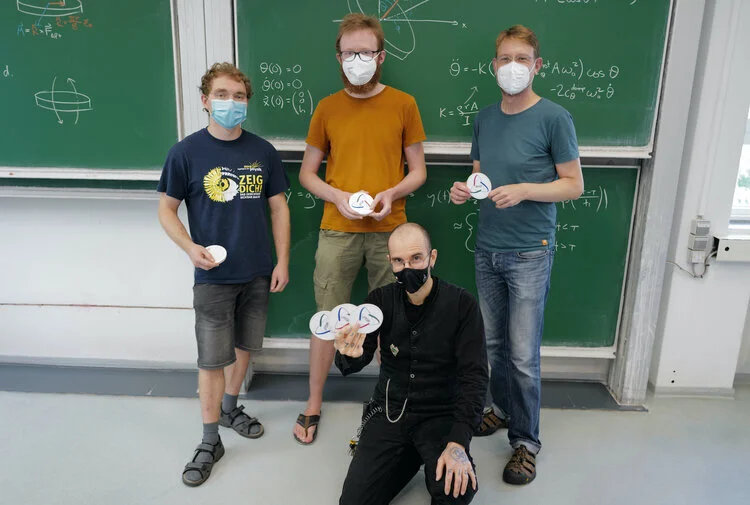
Bierdeckel-Physik
Uni Bonn 2021

20 Jahre Wissens-Podcast
Radioeins
2004-08-AIR: The Search for Tycho Brahe's Nose
In 1572, as a Student at the University of Copenhagen, Brahe observed a very bright star. He proved that it was a Supernova located outside our solar system. Brahe's later observations of the orbits of Cassiopeia and of a comet made clear that those objects, too, were located more distantly than our moon. All this meant that - contrary to what many people believed - the heavens were changeable, not immutable Šs Aristotle had long ago postulated. Still, Brahe avoided painting a heliocentric view of the universe; he described the earth, rather than the sun, as being at the center of all things heavenly.
Read More2003 AIR: Hitler´s Skull & Teeth
I am a true nerd I guess: Spectacles, checkered pattern shirt, no radio, no TV — a forensic entomologist by profession. So when National Geographic Channel called and asked the allegedly "most famous forensic biologist on earth" (my editorial house's claim, definitely not mine) to join into an investigation on the remains of Adolf Hitler, I nerdily thought it just a theoretical enterprise, and said yes. As with many people born in Germany long after World War II, I, to a large extent, regarded Hitler as a very bad, extremely cruel joke against mankind. I had never quite thought of Hitler as a real, physically present person. I have no fascination of any sort with the guy. Just look at him (see Figure 1) — he was a jerk amongst jerks.
Read More2001-09/10 AIR: Happyface Spiders
I am a forensic entomologist. Every forensic scientist's basic mantra is: Everything is possible. My professional experience leads me to believe that there is one place on earth where more than just everything is possible -- that place is Hawai'i. On this remote part of the U.S. lives a bug that directly contradicts all assumptions modern people might hold concerning eight-legged critters: that spiders are hairy, ugly and frightening. This kind of spider is anything but.
Read More2001-07/08 AIR: Scientific Dining
Mostly Special Agents, and Special Agents-To-Be are served a choice of meals that some good restaurants would dream of. However, the basic impression of all people that were approached by the author, was that "the food here was better in earlier times", that the meals were "well, so-and-so", or that the food was "jeeeez, yucky". Being asked what had been better at earlier times, the Famous Steak And Wine Evening was mentioned by older agents. Noone could recall, however, in which year exactly those evenings stopped, or on which day of the week the event had taken place. (Further investigation with veteran eaters narrowed it down to Wednesday or Thursday). Another disturbing comment of an eating agent was: "It's good that I was single when I first came to the Academy. If not, I would have driven home every night just for dinner."
Read More2000-05 AiR: Bomby The Bombardier Beetle Review
As a person unvoluntarily dealing with the borders of human behavior, I am used to all sorts of statements that seem to be weird in the beginning only to become resonable after digesting them further. I got to know, and to understand people of every possible color of skin, sexual preference, mother tongue, people who mutilate themselves for the purpose of self-expression, serial killers, cops, drug users, not to mention computer nerds (like my brother), and oddballish scientists (like myself).
Read MoreFingerprints of fingerless organisms
Quelle: Annals of Improbable Research 1(5): 26-27 (1995)
by Mark Benecke
Zoologisches Institut der Universitaet, Koeln, Germany
We developed a method to obtain fingerprint patterns of microscopic animals which have neither arms nor fingers. Two species are discussed here.
The Usefulness of Fingerprinting
Fingerless organisms can be as deadly as any human criminal. When loosed upona law-abiding public, they have been known to cause malaria and other tropical diseases. Criminologists have good reason to identify and catch the individual organisms responsible for such crimes. We often hear and read about criminal cases being solved by fingerprints. Nowadays, so-called "genetic fingerprints" are also used, especially in forensic medicine. The classical and the genetic fingerprinting methods are both powerful but limited. !t is hard to carry out the classical fingerprint technique in organisms without fingers, and the genetic method is quite expensive. Our method is cheap and simple.
How we do it
We apply a short treatment of silver nitrate and other standard photographic chemicals. This causes the fingerprint to appear.
Examples
Figures la and 2a show the "slipper animaI" (Paramecium caudatum), which is very common in fresh water. Elevations and grooves are clearly visible (Figure 2a) and allow us to make individual identifications. Other organisms, e.g. the "trumpet animaI" (Stentor polymorphus) (Figure Ib), show fundamentally different fingerprint patterns which often are much more beautiful and at the same time highly informative. Note that in Stentor, not only grooves are visible, but also winding lines and nice-looking dots (Figure 2b).
Future Hopes for Criminologists
In the future, using improved techniques, we should be able to ob ta in fingerprints not only of fingerless organisms but also of bodiless, supernatural beings such as zombies, ghouls and speeters which, in many countries, are of great interest to criminal investigators.
Preface: Fetish & Gothic Obsession
Nur wenige Fotografen des randständig Schönen haben einen Stil, der einem sowohl plakativ um die Ohren fl iegt als auch anderen als Anregung und Maßstab dient. Martin Black hat. Oft sind seine KollegInnen, die das Dunkle ausloten, vor allem düster. Das ist für Anfänger. Andere verspritzen Blut und Tränen, sind romantisch und mögen Feen oder lassen einfach den Hintergrund weg, um ihre Subjekte umso mehr ins Hirn der Betrachter zu beamen. Das ist schon deutlich cooler.
Read More